
There comes a point in a relationship when it becomes difficult to move forward. You may start questioning whether my relationship is worth saving. This question can change everything about your connection with your partner.
This exhaustion can be due to a multitude of reasons, including repeated unresolved conflicts, emotional distance, constant misunderstandings, unmet needs, lack of communication, trust issues, or feeling like you are the only one putting in effort.
However, how do you gauge whether you should continue your relationship? We have listed some signs that can help you measure whether you should stay or leave your relationship. These signs will also aid you in understanding how much effort you should put into your current or future relationships.
Before You Decide: One Important Clarification
Before you decide, it’s important to clarify one thing. Not every struggling relationship is unhealthy, and not every difficult relationship should be saved. This article focuses on long-term patterns, not occasional bad days or arguments.
- Struggle does not always mean failure
- Effort alone doesn’t equal sustainability
- The goal here is clarity, not guilt
What Does A Struggling Relationship Look Like?
A struggling relationship doesn’t always mean something is broken beyond repair. In many cases, it reflects a rocky phase where connection feels strained but not lost. You may notice more frequent misunderstandings, repeated arguments about the same issues, or emotional distance slowly replacing closeness. Conversations that once felt easy may now feel tense, rushed, or avoided altogether.
Some common, normal signs of a rocky relationship include:
- Having the same argument without reaching a resolution
- Feeling unheard or emotionally dismissed
- Spending more time avoiding difficult conversations
- Noticing reduced affection or emotional closeness
A relationship becomes “struggling” not because challenges exist, but because those challenges aren’t being addressed effectively. With awareness, effort, and communication, many of these signs can be worked through and may even strengthen the relationship.
7 Questions to Ask Yourself Before Ending Your Relationship
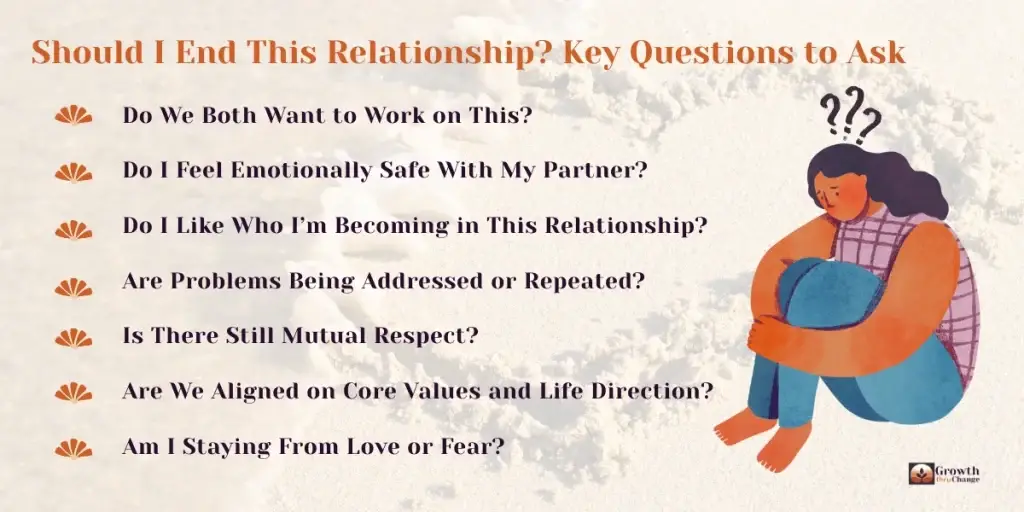
If you are stuck in the deep phase of understanding whether your relationship is worth it, you should start asking some questions. You are meant to ask these questions before you end your actual relationship. Make sure you are open-minded and answer yourself honestly.
1. Do We Both Want to Work on This?
A relationship can only improve if both partners are genuinely willing to put in effort. Words like “I’ll try” or “I promise to change” matter far less than consistent action over time. Ask yourself whether effort shows up regularly, or only when things are about to fall apart.
2. Do I Feel Emotionally Safe With My Partner?
Emotional safety means being able to speak honestly without fear of ridicule, punishment, or dismissal. This doesn’t mean conversations are always comfortable, but they should be respectful. If honesty leads to blame or shutdown, safety may be missing.
3. Do I Like Who I’m Becoming in This Relationship?
Healthy relationships support growth. If you feel smaller, less confident, or disconnected from your values, that’s worth paying attention to. Occasional discomfort is normal, but losing yourself is not.
4. Are Problems Being Addressed or Repeated?
All couples argue, but the real question is whether conflict leads to understanding or simply repeats. If the same issues resurface without progress, it may signal avoidance rather than resolution. Change, even slow change, matters.
5. Is There Still Mutual Respect?
Respect shows up during conflict. Name-calling, contempt, dismissiveness, or stonewalling slowly erode trust. Disagreements can exist without cruelty. Without respect, repair becomes increasingly difficult.
6. Are We Aligned on Core Values and Life Direction?
Love alone can’t bridge big differences around children, finances, lifestyle, or long-term goals. Ask whether your visions for the future still align, or if compromise has become self-sacrifice.
7. Am I Staying From Love or Fear?
Fear can be powerful. Fear of loneliness, starting over, or wasting time can keep people stuck. Love feels different; it includes care, intention, and hope. Understanding your motivation brings clarity.
Also Read: Power Struggle in Relationships
Signs Your Relationship May Be Worth Saving
When a relationship feels strained, it’s natural to focus on what’s broken. But certain signs suggest that, even in difficult moments, there may still be a foundation worth working on. These signs don’t promise an easy fix; they point to potential, which matters when deciding whether to keep trying.
Both Partners Take Responsibility
One of the strongest indicators of a salvageable relationship is shared responsibility. This means neither partner carries all the blame. Instead:
- Both of you can admit mistakes without excessive defensiveness
- There is openness to feedback, even when it’s uncomfortable
- Effort isn’t limited to apologies but includes behavior changes
Responsibility shows a willingness to grow rather than stay stuck.
Emotional Safety Still Exists (Even If It’s Strained)
Emotional safety doesn’t mean conflict-free. It means respectful honesty is still possible. You may argue or feel hurt, but there’s an underlying sense that your partner cares about your feelings. If you can express vulnerability without fear of being mocked, ignored, or punished, emotional safety is still present and can be strengthened.
Repair Happens After Conflict
Every couple fights. What matters is what happens afterward. If you’re able to return to the conversation, reflect, apologize, or reconnect, even imperfectly, that’s a positive sign. Repair attempts show that the relationship matters more than “winning” an argument. Over time, these efforts rebuild trust.
Growth Has Happened Before
Think about the past. Have you worked through difficult phases together? Have communication patterns improved, even slowly? Previous growth suggests the relationship is capable of change. Progress doesn’t erase current struggles, but it shows resilience and the ability to adapt.
Love Hasn’t Turned Into Indifference
The opposite of love isn’t anger, it’s indifference. Feeling frustrated, sad, or even angry often means the relationship still matters to you.
- You still care about your partner’s well-being
- Conflict hurts because emotional attachment is still present
- You want things to improve, not disappear
As long as there is care beneath the frustration, emotional investment remains—and that means there is still something meaningful to work with.
Signs It May Be Time to Let Go
Deciding to leave a relationship is never easy, especially when you’ve invested time, care, and hope. Sometimes, letting go isn’t about giving up; it’s about protecting your emotional and physical well-being. The signs below are not judgments; they are signals that staying may be causing more harm than healing.
- Ongoing emotional or physical abuse: Any form of repeated harm, control, intimidation, or violence is not something love or effort can fix. Safety must always come first.
- One-sided effort over time: If you are consistently trying to communicate, repair, and grow while your partner remains disengaged, the imbalance can become emotionally draining.
- Loss of trust with no repair: Trust can be damaged, but when there is no accountability, change, or willingness to rebuild it, the relationship may no longer feel secure.
- Chronic contempt or resentment: Constant criticism, sarcasm, or emotional withdrawal can slowly erode connection and create lasting emotional wounds.
- Staying feels like self-betrayal: If remaining in the relationship requires ignoring your needs, values, or sense of self, it may be a sign that leaving is an act of self-respect.
Choosing to let go can be a compassionate decision, for yourself and for the future you deserve.
Also Read: Types of Emotional Abuse that are not Physical
Is It Normal for Relationships to Be This Hard?
Yes, it’s normal for relationships to require effort and thoughtful work, and that’s actually a sign of emotional investment rather than failure. According to relationship guidance on building and maintaining healthy connections, relationships take dedication and open communication to stay strong over time.
However, effort should not feel like constant emotional pain or depletion. Healthy relationship work may involve uncomfortable conversations or moments of growth, but it should gradually build understanding, respect, and connection, not leave you feeling drained or unsafe.
For example, the NHS recommends open and honest discussions, where both partners feel heard and respected, as a core component of strong relationships.
If the challenges you’re facing consistently outweigh feelings of safety, support, and mutual growth, it might be worth exploring what’s beneath the difficulty. But normal effort should feel like progress over time, not constant emotional pain or loss of self. Understanding this helps you see the difference between normal relationship work and persistent harm, allowing you to make clearer, kinder choices for your well-being.
What If You’re Still Unsure? You May Need To Talk To Someone
If you’ve read this far and still feel conflicted, that uncertainty is important. It often means there are deeper patterns, unspoken emotions, or unresolved hurts that are hard to untangle on your own. Talking to a trained professional can help you slow things down, feel heard, and gain clarity without pressure or judgment.
At Growth Thru Change, couples therapy is designed to support you whether you’re trying to repair your relationship or understand what you truly need moving forward. Therapy isn’t about blaming one partner or forcing a decision; it’s about creating a safe space to explore what’s happening between you.
Our couples therapy can help you:
- Improve communication and reduce recurring conflict
- Understand emotional needs and attachment patterns
- Rebuild trust after disconnection or betrayal
- Feel emotionally safe expressing thoughts and feelings
- Decide next steps with clarity rather than fear
Our therapists use evidence-based approaches like Emotionally Focused Therapy (EFT) and the Gottman Method, tailored to your unique relationship dynamics. Sessions are collaborative, compassionate, and focused on real change, not quick fixes.
You don’t have to have all the answers before starting therapy. Sometimes, talking to someone is how the answers begin to emerge.
Take the first step toward clarity and connection.
Schedule a couples therapy consultation with Growth Thru Change today
Conclusion
Relationships aren’t all rainbows and unicorns. They are hard, complex emotional engagements that involve the attention of both people involved. However, even if you are head over heels in love with someone, you might still think about whether your relationship is worth saving.
But it is. If you inspect the signs we have listed, you will be able to find out if your relationship is compatible for the future. However, if you might be carrying the burden for longer than you had assumed, it may be time to seek the help of a professional.
We at Growth thru Change help couples discover their relationship issues in a safe, non-judgmental space. We have helped 30+ couples in Philadelphia seek better therapeutic care on an immediate basis.
If you or your loved one may benefit from a conversation, schedule a free consultation.
If you are ready to commit to a couples therapy session right away, click here.


